Workshop preparation
Are you preparing to give a workshop on mobile web-servers? If so, find below a couple tips and tricks gathered during previous workshops.
To best prepare for the workshop, we strongly advise you to follow the tutorial a couple times before-hand, preferably on different Android models. That way you will be more comfortable trouble-shooting issues.
Group level adaptation
Depending on the technological literacy level of your participants, you may want to adapt the workshop to make it accessible. For example, instead of each person building a web-server on their (old) smartphone, you can make groups with participant of different levels, so they can help each others.
Alternatively, you could only create the server on 1 phone, especially if your crowd is uncomfortable with touch screens.
Lastly, there is also a web-server app that can be downloaded via F-Droid that can also serve html files. This would enable you to focus more on the theoritical part and customising an HTML instead of the terminal. In that case, Termux isn’t necessary. Download IWS Lightweight webserver
Workshop resources
On top of the online tutorial on this website, we have prepared several additional documents for the workshop. First, there is an annotated version of the tutorial for the facilitator to best guide the workshop: - The Annoted presentation, with the theorical presentation to Internet, servers and the terminal (see facilitator notes). - The Annoted tutorial, with the practical step-by-step instructions, including tips and tricks, workshop guidance, break times, etc. - The Annotated printable version. The full tutorial in printable version (`ctrl + P’ to print). Secondly, there is printable hand-out for participants, so they don’t have to take notes, and can follow at their own rhythm.
Workshop structure
The workshop is designed to be given by one or two facilitator, for an audience of 10 people approximately. The online tutorial can be projected to a beamer screen, while participant follow on their phones and with the own hand-outs. The facilitator(s) can keep the annotated version on their own laptop.
Materials needed
- Old Android Smartphones brought by participants
- Beamer/screen
- Laptop for facilitator
Optional by better:
- External keyboards with bluetooth, micro-USB or USC-C connection, so you can plug it to your phone to type easier.
- A few old Android phones with Termux and Nginx already installed on it: in case of issues with phone’s participant, they can use one as a back-up.
Before we start — What do we need?
We need… A smartphone
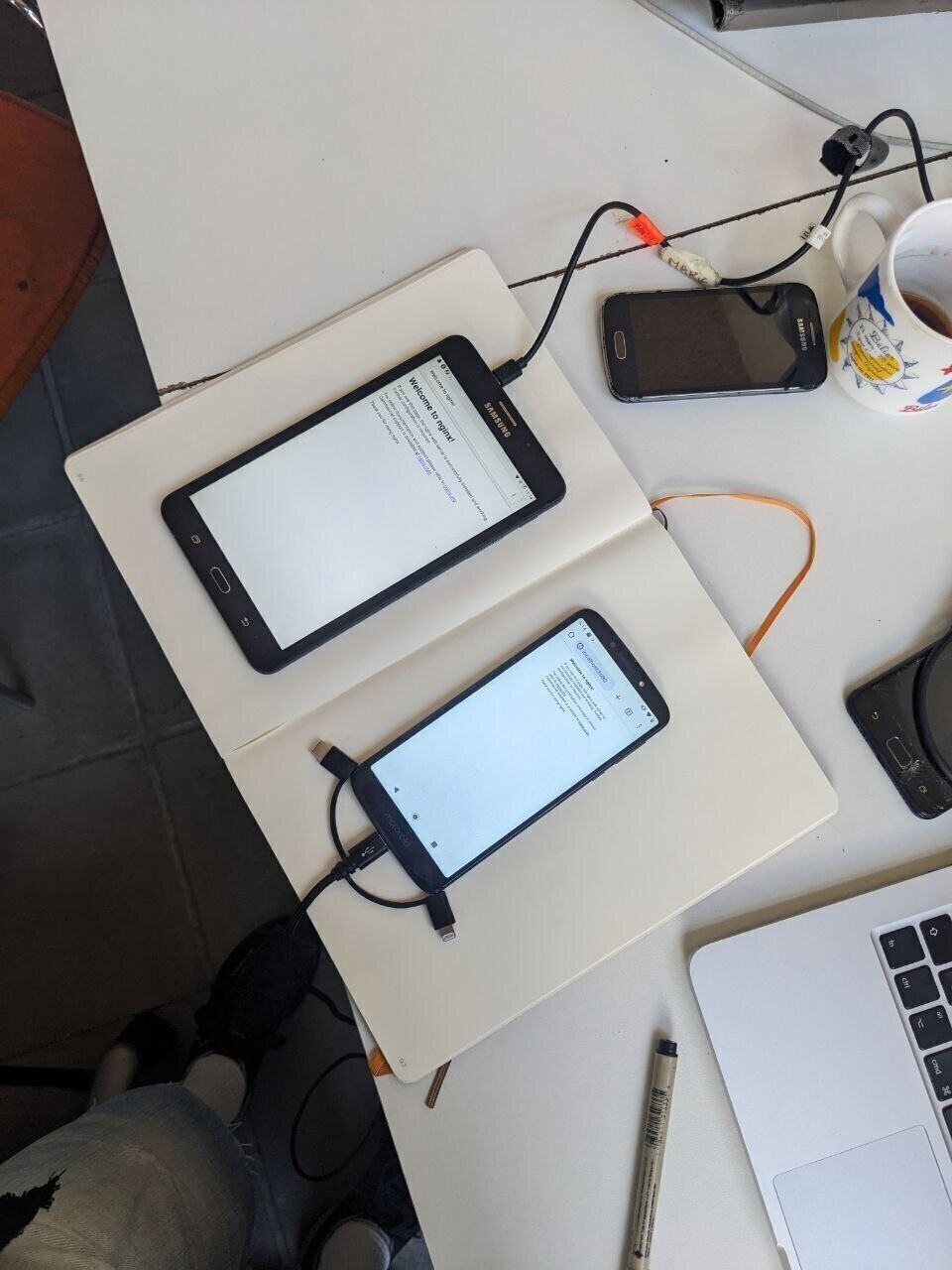
This tutorial is made for Android smartphones and tablets from the last 10 years (2015-2025). In case your phone is older than 10 years, not an Android phone, or you are working with a laptop, look below at the alternatives.
You can use your daily phone or an older “retired” device. It can be a bit damaged but the following features are necessary:
- Android 5 or above (Android 7 or above is preferable) (check in Settings > About Phone)
- The Wi-Fi functions.
- The charging port works.
Optional but better:
- The touch screen works, even though it could be shattered. If you don’t have a working screen, check out these solutions.
- The battery functions, or you have an external battery.
Alternatives
iPhones and iPads
Termux — the app we use in this tutorial — is not available on iOS but there is an alternative app called iSH available on iOS 11 and +. Some web-server tutorials are available online (using iSH and python web-server).
PostMarketOS
If your Android phone is simply too old, cannot update or you are looking for a different (radical) approach, check out PostMarketOS.
PostMarketOS is an alternative Linux OS that is free, open-source and community maintained. You can install it as a replacement for Android and extends your phone’s lifespan beyond its programmed software obsolescence (lack of updates). You can then easily install the web-server software of your choice, following a linux web-server tutorial.
more info will be added here.
Laptops
If you don’t have a spare phone but a spare laptop, you can install Linux on it and deploy a web-server too. Simply look for “installing nginx on Linux” tutorial.
Factory Reset your phone + Google’s FRP (optional)
This step is optional, but it might be handy to clean up your phone before deploying it as a web-server. It will give you more storage space, and prevent other apps to overtake computing power.
To do this, online search your device model + factory reset. You will find some instructions to access the boot mode of your computer, from which you can select wipe phone or factory reset. A good website is Hard Reset.
Before you reset your phone:
- Back-up the the contents your want to save, it will be erased.
- Make sure to disconnect any Google Account in Settings > Accounts. Otherwise you risk facing Google’s FRP protection prompting you to login again to the previous Google account, which would make your phone (almost) unusable. This makes it harder to start with a phone you bought or got from someone else.
Smartphone set-up
Make sure your phone is:
- Accessible (you have the password)
- Connected with the internet on a Wi-Fi network
- Equipped with a web-browser (for example, Mozilla Firefox or Chromium).